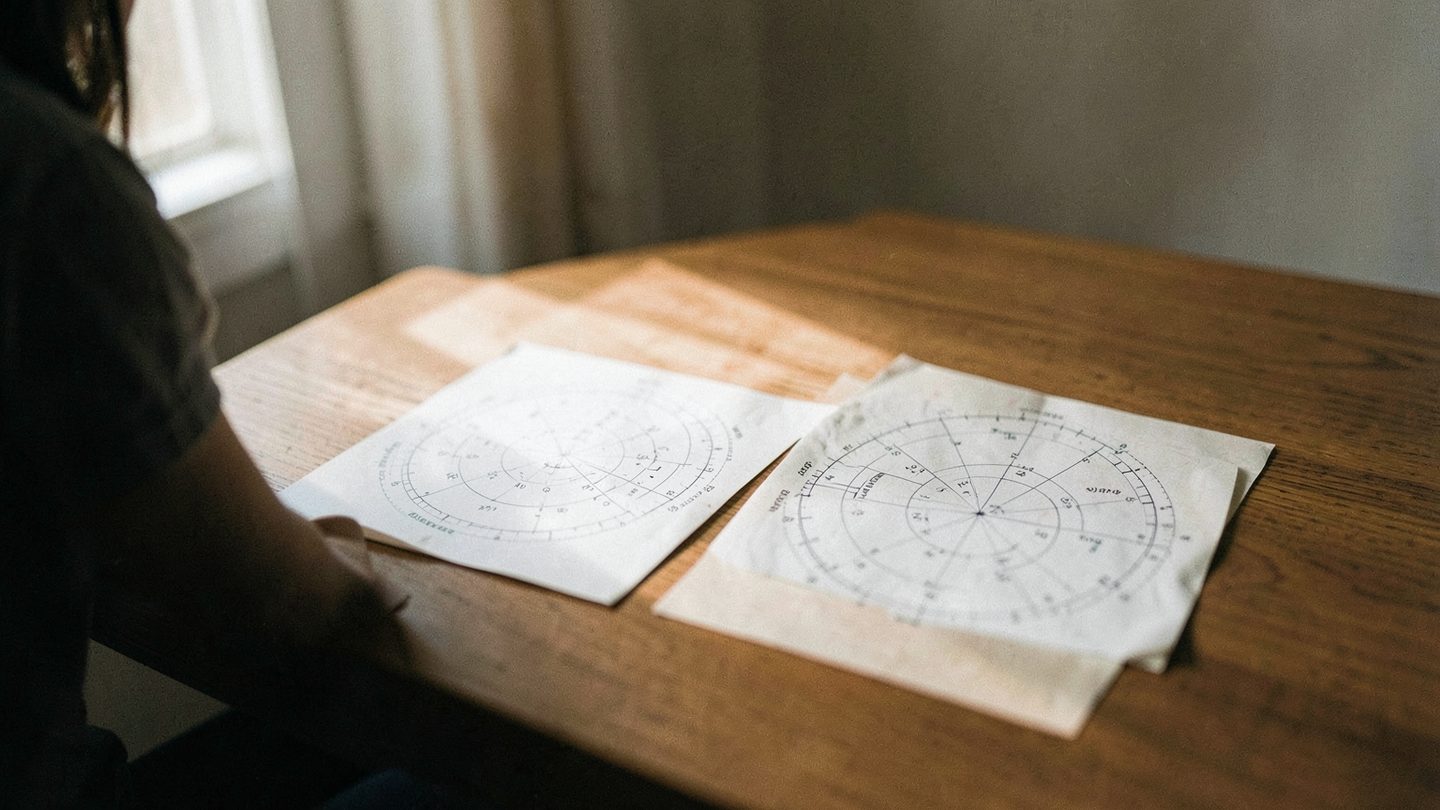
Lead with the reader’s real question
The question that pulls most people into a lunation reading is personal: Is this one about me? You want to know whether the new moon will touch your love life, your work, your money — and whether a change is coming.
That question is fair. The mistake is asking it before you compare the lunation to your own birth chart. A lunation announced in the news describes a collective mood. A lunation that forms an aspect with one of your natal planets describes your life.
Suppose a new moon lands in your 7th house. That house covers partnership: what you negotiate, where you bend, who you choose. Does that mean an engagement or a breakup is on its way? No. It means relationships become the area where the coming weeks ask for your attention. The outcome depends on what you do with that focus.
So the real question is not “what will happen?” It is “where is my attention being called?” The first invites a prediction you cannot verify. The second gives you a reading you can actually act on.
What to look for in a lunation chart
Start with the sign, because it sets the tone. A new moon in Capricorn carries the mood of structure, ambition and accountability; the same lunation in Pisces shifts toward imagination, longing and surrender. The sign tells you the flavor of the weeks ahead.
Next, find the house. The house is the address where that flavor shows up. The 2nd house puts the theme on money and self-worth; the 10th on your public role and direction; the 5th on romance, creativity and pleasure. A lunation in any sign means little to you until you know which room it is standing in.
Finally, check the aspects. This is the step that turns a collective event into a personal one. When the lunation sits within a few degrees of an angle to one of your natal planets — a conjunction, square, opposition or trine — it presses directly on that planet's territory. A full moon conjunct your natal Venus in the 10th merges the sign's tone, the career stage and Venus's themes of love, value and connection into one focused theme. It is not a promise of a raise; it is a signal that your professional world and your values are about to demand attention together.
If a lunation makes no aspect to any of your natal planets, read it as collective atmosphere, not personal instruction. The astronomy is still real — the moon really is full — but your chart is not asking anything of you. The harder reading comes when the lunation squares a natal planet, because that friction means something specific about where you must act deliberately.
How to separate symbolism from prediction
A house is the stage, not the script. When a new moon lands in your 7th house, it switches on the partnership themes — negotiation, balance, and what you expect from the people closest to you — for the coming weeks. Whether you end up redrawing a household agreement, deepening a commitment, or noticing how much you quietly defer depends on what you do with the spotlight.
That is the core divide. A symbolic reading asks: What theme is being activated, and where? A predictive claim says: This event will occur. The first is a map of your attention. The second is a promise about outcomes. Lunations are maps, never promises.
The practical test is to phrase your reading as a question about a theme, not a statement about an event. Instead of telling yourself “this full moon means I will get promoted,” say “this full moon in my 10th house is highlighting how I am seen at work — what do I want to change there?” The theme holds up. The event does not.
The chart contact gives the reading its weight. A lunation square to your natal Saturn in the 6th house marks friction around work, routines, and responsibility. That friction is information: it shows where you must adjust deliberately. It is not a verdict that your job will collapse. The specificity comes from the placement, not from the certainty of the outcome.
So read a new moon as an invitation to begin something within its theme, and a full moon as an invitation to release something within its theme. If you want the full-moon-specific method for your own chart, this three-check guide walks through the sign, house, and aspect contacts that keep the reading grounded. The sky marks the moment. Your choices write what happens next.

What an aspect can suggest, and what it cannot prove
An aspect describes how a lunation touches your chart; it does not decide what happens. Each angle has its own voice. A conjunction merges the lunation's theme with a natal planet's territory — imagine a new moon conjunct your natal Mars, charging drive, desire and initiative for the whole coming cycle. A trine lets that theme flow through the planet's territory with ease. An opposition splits your attention between two poles. A square adds friction.
The square is the one that creates the most noise, so it deserves a closer look. A full moon squaring your natal Venus does not signal a breakup. It marks a pressure point between the moon's work of emotional release and what you value in love, money or pleasure. You feel the pull: an old habit of seeking approval colliding with a need to be honest about what you actually want. That friction is an instruction to adjust deliberately, not a forecast of loss. The Neptune-Saturn square is a vivid example of that friction: two demanding themes pressing against each other until you choose how to adjust.
What no aspect can prove is the event. No square predicts a fight. No trine guarantees a windfall. No conjunction appoints a new job. The aspect names the quality of contact and the area where your attention belongs. The outcome still depends on the choices you make inside that focus.
So when you spot a lunation aspect to one of your natal planets, let the aspect's voice set your next move. A conjunction asks where to invest energy. A square asks what to adjust consciously. An opposition asks what to balance. A trine asks what to receive.
| Aspect | What it suggests | What it asks of you |
|---|---|---|
| Conjunction | Merges the lunation's theme with that planet's territory | Choose where to invest the concentrated energy |
| Trine | Lets the theme flow through that territory with ease | Receive what surfaces without forcing it |
| Opposition | Splits your focus between two poles | Find the balance both sides need |
| Square | Adds friction that demands adjustment | Act deliberately where you feel the tension |
How the free birth chart tool helps you compare charts
The free birth chart calculator gives you the reference map you need. Enter your birth date, time and location, and the tool lists your natal planets with their signs, houses and degrees. That list becomes your comparison sheet for any lunation that comes up.
The comparison itself is straightforward. Note where your key natal planets sit — your Sun, Moon, Venus, Mars and Saturn. Then look at the lunation's degree in the sky. If the new or full moon lands within a few degrees of a conjunction, square, opposition or trine to one of those planets, that lunation is speaking directly to you. Want the degrees checked for a specific date? The transit chart calculator does the same work with the lunation date built in — enter your birth details and the date, and it shows the contacts.
Here is a concrete example. Say your natal Mars sits at 12 degrees of Virgo, and a new moon occurs at 10 degrees of Virgo. That is a conjunction: the lunation merges with your Mars territory, charging your drive and initiative for the whole coming cycle. Now imagine that same new moon in Pisces with no natal planet within a few degrees of an aspect. You can still feel the collective mood, but your chart is not asking anything of you. It is calendar noise, not a personal turning point.
One practical note on inputs. Sign and aspect comparisons work from your birth date alone. Reliable houses and a rising sign need your birth time and birth location too, so enter them if you have them — the rising sign calculator will show your Ascendant when you have the full details. Without a birth time, skip the house reading and stay with signs and aspects — they still carry the comparison.
That is the real value of the tool. It turns a lunation from a headline into a personal map. You stop asking whether the moon is about you and start seeing the answer in the degrees. The reading becomes something you can act on, not something you wait to happen to you.
Common questions about lunations, houses, and timing
How long does a lunation actually touch you? A new moon opens a theme that builds through the waxing half of the cycle — roughly the two weeks until the full moon. A full moon marks the release point, and its theme settles over the two weeks that follow. The aspect contact with your chart sets when you feel it most, but the window is that half-cycle, not a single night.
What if you don't know your birth time? Then the house placement is unreliable, because the houses shift every couple of hours as the sky rotates. You can still read the sign and the aspects to your natal planets — those two layers carry the personal weight. Drop the house from the reading rather than guess at it.
Is every lunation worth reading? No. If no natal planet sits within a few degrees of an aspect, nothing is being asked of you personally — most lunations pass by as background. Track upcoming dates on the astrology calendar, and save your focus for the ones that make actual contact. For the step-by-step full-moon method, this guide walks through the sign, house, and aspect checks.
So what do you do with the reading? Name the theme, locate it, then choose one concrete action. A new moon in your 2nd house is a nudge to review your budget. A full moon in your 5th house is an invitation to finish a creative project or release a pleasure that drains you. The lunation names the moment. Your action writes what happens next.
Sources
This article teaches a general method for reading any lunation by sign, house, and aspect. Because it does not anchor to one specific lunation date, it deliberately avoids a numbered sign shortlist and labels possible life areas as themes rather than certainties. Reliable houses and angles require an accurate birth time and location.