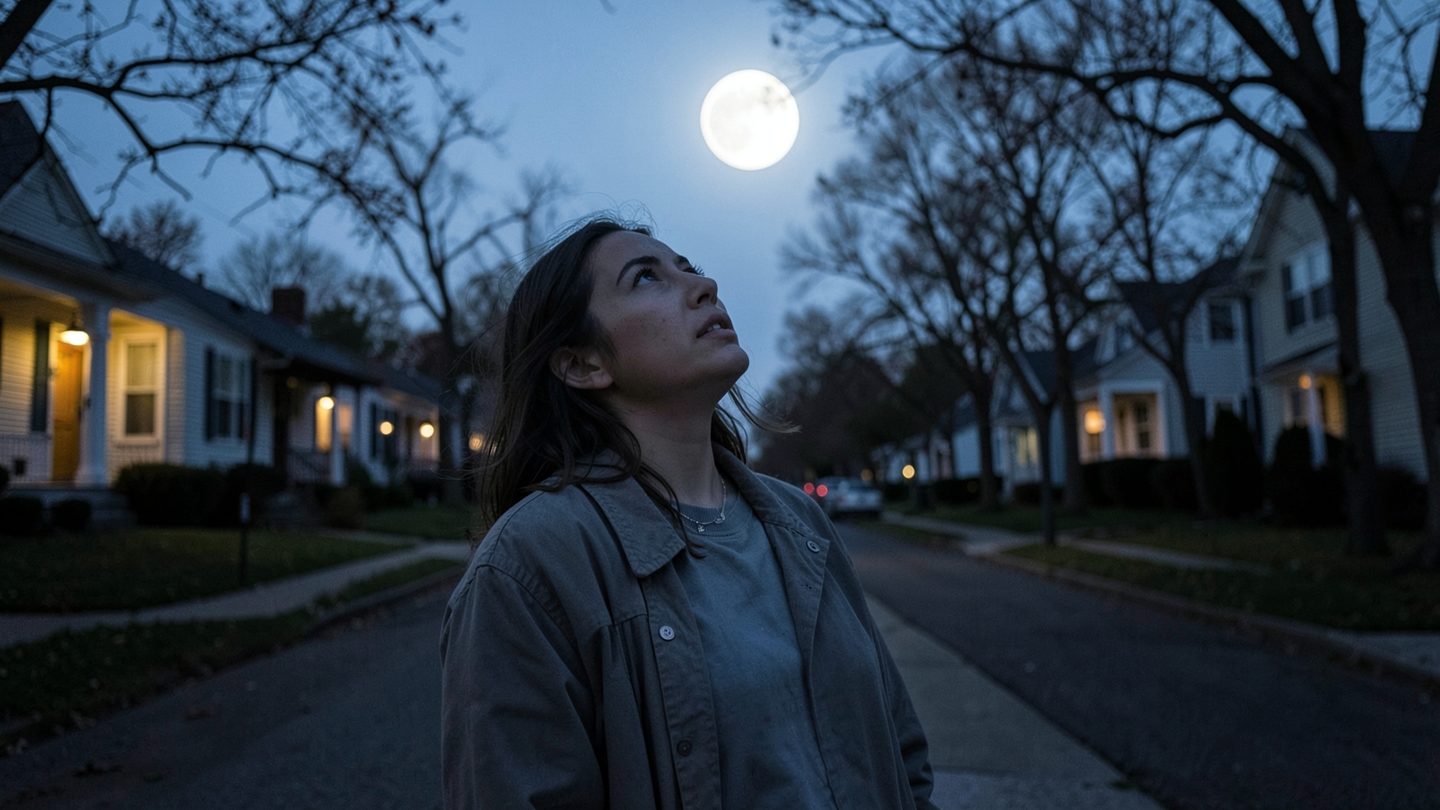
Date and phase: what this full moon is, and why the exact degree matters
A full moon is simply the moment the Moon stands opposite the Sun in Earth's sky, with the side facing us fully lit, as NASA's moon facts describe. In astrology, that opposition is the whole point: two signs, two demands, one date.
This one peaks at 16:49 UTC on September 26, 2026. That's 12:49 p.m. EDT, so most of North America gets it in daylight and watches the illuminated disc rise after sunset. Space.com calls this the Harvest Moon, and it notes the Moon glows opposite the Sun — the same geometry our chart calculation uses. Harvest Moon is a sky-watching label for the full moon nearest the autumn equinox; it says nothing about what the lunation means in your chart.
Now the detail that decides everything for you: the Moon sits at 3.62° Aries, the Sun at 3.62° Libra. Those two numbers match to within 0.0001° of a perfect 180° opposition. This is one of the tightest lunations of the year, which means the degree matters enormously.
Why? Because a wide full moon grazes your chart and leaves. An exact lunation falls on a precise degree. If you have anything near 3°37′ of Aries, Libra, Cancer or Capricorn — the cardinal signs — the Moon lands on that exact point, like a key in a lock that actually turns.
Aries is the Moon's host here, so the emotional register is fast, blunt and self-directed. If your Moon is in Aries or your chart leans on this axis, the feeling won't be vague restlessness; it will be an urge to say the thing you've been swallowing. That's the Moon in Aries signature: react first, explain later.
One more calculated detail worth knowing before you read anything into your week: Saturn sits at 11.91° Aries, retrograde, only 8.29° from the Moon. That's a wide conjunction, not an exact one. It flips the usual full moon script.
Instead of a sudden emotional break, you get pressure to make something real — a demand for structure, a limit you can't dodge, a choice that suddenly has consequences attached. Saturn in the same sign as the Moon doesn't erupt. It weighs.
| Point in the sky | Calculated position | Effort/time to check |
|---|---|---|
| Moon | 3.62° Aries | Find this degree in your birth chart |
| Sun | 3.62° Libra | Opposite the Moon to 0.0001° |
| Saturn | 11.91° Aries retrograde | 8.29° from the Moon — a wide, not exact, contact |
| Event time | 16:49 UTC, Sept 26, 2026 | Compare with your local clock |
| Peak window | Roughly two days either side | Read it, then wait before acting |
The astrological themes: what Aries full moon symbolism points to without overpromising
Aries is the first sign, the one that acts before it checks with anyone. A full moon in Aries puts the emotional spotlight on what you want, right now, in the room you are standing in — and the Libra Sun opposite insists someone else is in that room with a different preference. That is the theme: me versus we, appetite versus agreement, the honest impulse versus the polite delay.
Read the Sun opposite Moon axis and you get the shape of the tension. Libra wants the relationship to stay level. Aries wants the truth out. Under this lunation most people feel both at once, and the friction lands wherever 3°37′ Aries falls in their chart. If that degree sits in your 7th house, the fight is probably with a partner. In your 5th, it is a creative or romantic claim you keep postponing — the project you keep not starting, the person you keep not asking. In your 4th, it is family. Same sky, different address.
Saturn is the reason this one feels less like a cathartic cry and more like a boundary you have to draw. With Saturn at 11.91° Aries retrograde, 8.29° from the Moon, the lunation carries weight rather than discharge. As Cafe Astrology frames the day, it is a time for revelations about independence, leadership and close partnerships — again, a pressure to name something, not an invitation to spiral.
A wide Saturn contact means the choice in front of you has a cost attached, and you already know roughly what it is. Aries energy without Saturn is a spark. Aries energy with Saturn asks: what are you actually willing to stand behind when it stops being fun?
So the honest theme is not release. It is reckoning with your own appetite — and deciding whether the resistance you meet is a wall or a mirror.
Whether your chart actually takes that pressure is a separate question, and it has three answers.
Chart context: the three checks that tell a reader whether it hits your chart
Start with the house. Open the transit chart calculator, enter your birth date, birth time and birth location, then set the target date to September 26, 2026. Find 3°37′ Aries on the wheel — the Moon's exact degree — and note which house cusp range contains it: scan the house cusps until you find the two boundaries that bracket 3°37′ Aries, and that span is your answer. That house is the room where this full moon plays out — money, partnership, career, family, health.
This is also why a date alone won't do. The rising sign, the houses and the angles all shift fast with the clock, so the calculator needs birth date, birth time and birth location together, and it will ask for all three. If your birth time is unknown, treat the whole exercise as approximate until you can recover it: a noon chart will place 3°37′ Aries in some house, but that house can change within hours, so the reading is provisional rather than settled.
If you only have ten minutes, this is the check to run. Everything else is refinement.
Check two: does 3°37′ of any cardinal sign sit within a degree or two of your Moon, Sun, Venus, Mars, Saturn or Ascendant? A contact that tight is the difference between reading about the full moon and living it. A planet at 4° Cancer, for instance, sits square to the Moon — an internal push, not a public event. A planet at 3° Libra sits conjunct the Sun, and the pressure arrives through a relationship.
Aspect geometry is measured, not eyeballed from sign degrees. Two planets in the same sign are not automatically conjunct; only calculated longitudes tell you the real separation. That is why the calculator exists.
Check three: the axis itself. The Sun–Moon opposition is exact to within 0.0001°, so the Libra–Aries line is live. If your chart already stacks points on 0–10° of Aries or Libra, this lunation amplifies a story you are mid-way through, not a new one. If your cardinal degrees sit near 0° or 29°, you get the edge of it — noticeable, not nuclear.
Now the Saturn question. The calculated separation between the Moon and retrograde Saturn is 8.29°, a wide conjunction. That is not an exact hit, so this is not the heavy, fated full moon headlines imply. It is decisive rather than crushing: a limit becomes visible, and you get to choose what you do about it. If your natal Saturn, Moon or Ascendant sits near 11–12° Aries, Saturn's part of the story is personal. Otherwise it stays background weight.

Reflection prompts: the questions that separate reaction from signal
The full moon peaks at 16:49 UTC, but your reaction will arrive earlier and louder than the event itself. That gap is where the work is. Ask these before you send the message, quit the thing, or decide the relationship is over.
First: what did I already want before today? If you can name the desire from last week, this lunation is confirming something, not creating it. If the urge appeared today, out of nowhere, sit on it for 48 hours. Aries energy is fast; it is also often wrong about the size of the problem.
Second: whose preference am I actually arguing with — mine, or the one I assume they hold? The Libra Sun opposite an Aries Moon splits the room into self and other, and half the heat comes from a conversation you have not had. Say the sentence out loud to no one. Notice whether it still feels urgent.
Third: what would I do if this were permanent instead of a mood? Saturn retrograde in Aries adds stakes, not adrenaline. Run the choice through a one-year lens. If it survives that, it is signal. If it shrinks, it was weather. This is the hardest prompt to answer honestly under a cardinal full moon — that is the normal condition, not a failure — and it is also the one that matters most, because Saturn's permanence test is what separates a real position from a passing mood.
Fourth: which house is this? If 3°37′ Aries falls in your 7th, the pressure is about a partner. In your 2nd, it is money or worth. Same feeling, different arena — and the arena tells you what to actually do next.
Write the answers down. Then reread them after the Moon leaves Aries: a cardinal lunation hits hard and resolves quickly, so whatever still reads true once the speed has fallen away is the part worth acting on.
What comes next: how to use the free transit chart and what to watch over the following weeks
The peak is a moment, not a month. What you do with the next fortnight decides whether this lunation becomes a scene you replayed or a line you actually moved.
Start with the transit chart calculator. Enter your birth date, birth time and birth location, then choose September 26, 2026 as the target date. You'll see the Moon at 3.62° Aries sitting opposite the Sun at 3.62° Libra laid over your own wheel — your houses, your angles, your planets. Move the date forward a few days and watch the Moon leave Aries and travel on. That moving picture is the useful part: it shows you the difference between a passing mood and a pattern your chart already holds. If you want the timing spread across the whole month rather than one selected moment, the monthly forecast expands it.
If you don't yet know your rising sign or houses, run the birth chart calculator first; the transit tool needs those points to place the Moon in a house at all.
Then look ahead. The waning fortnight runs to the October 10, 2026 new moon at 17° Libra, and that window is where the full moon stops being reactive and starts being usable. The impulse has already peaked. Whatever it surfaced — a limit, a sentence you finally said, a decision you keep circling — is now raw material. The Sun opposite Moon axis that defines this lunation also defines what the new moon will ask you to do with it: the Libra side wants agreement, the Aries side won't sign anything it doesn't mean. Act on what surfaced rather than re-feeling it.
One test worth applying before the new moon: does your answer still hold once the Moon has moved out of Aries? If the urge fades within two days, it was Aries speed, not your actual position. If the point still stands a week later, it belongs to you and you can build on it.
Watch late September and early October for the surrounding weather. The astrology calendar lists the collective events so you can see what lands next, and the Moon sign calculator is useful if you're tracking daily mood shifts between now and then — remember that a Moon sign can be ambiguous on a day it changes signs if you don't have a birth time.
Finally, keep your saved chart. The value of running one lunation is not the reading itself; it's having a baseline you can compare the next full moon against. Charts reward repetition, not single sittings.
That is the whole method: place the degree, check the contacts, read the axis, then watch what survives the week. The full moon shows you where the pressure sits. What you decide to do with it stays entirely yours.
Calculation note · Calculated sky positions at the event
- Sun
- 3.6198° libra; ecliptic longitude 183.6198°; direct; longitude speed 0.9801°/day
- Moon
- 3.6197° aries; ecliptic longitude 3.6197°; direct; longitude speed 13.5477°/day
- Mercury
- 24.8019° libra; ecliptic longitude 204.8019°; direct; longitude speed 1.4077°/day
- Venus
- 7.6801° scorpio; ecliptic longitude 217.6801°; direct; longitude speed 0.2399°/day
- Mars
- 29.1646° cancer; ecliptic longitude 119.1646°; direct; longitude speed 0.5911°/day
- Jupiter
- 18.8089° leo; ecliptic longitude 138.8089°; direct; longitude speed 0.1848°/day
- Saturn
- 11.9133° aries; ecliptic longitude 11.9133°; retrograde; longitude speed -0.0773°/day
These are calculated geocentric positions, not evidence that planets cause personality or relationship outcomes. Houses and angles require a location and birth time. An illustrative snapshot does not describe the reader.
Sources
- NASA Science: Moon Facts
- NASA Science: Moon Phases
- Space.com: September full moon 2026 — When, where and how to see the Harvest Moon
- Cafe Astrology: September 26 2026
- Table Magazine: Your Full Moon in Aries Horoscope: September 2026
- Parade: What Each Zodiac Sign Needs to Release Under the September 26 2026 Aries Full Moon
Astrology is interpretive. The positions here are calculated geocentric sky data at the stated UTC moment; a birth date alone cannot establish houses, angles or an exact Moon sign, and those need a reliable birth time and place. Nothing in the chart decides an outcome for you.