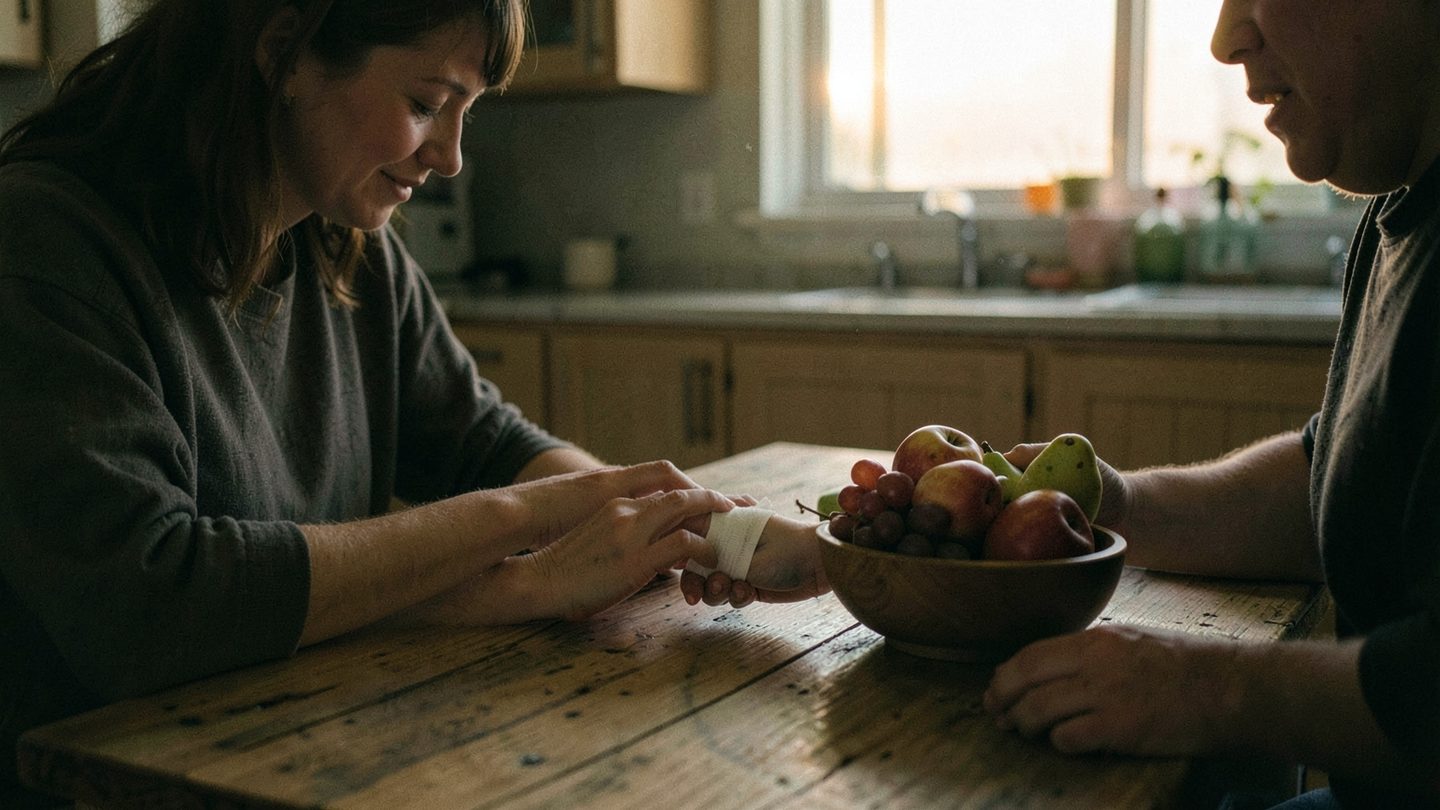
When your Chiron sits at 90° to a partner's Ceres, the pairing is not doomed. It is wired. One person's wound lands directly on the other person's instinct to feed, fix and hold things together — and the second person almost always answers before thinking.
Picture the loop in motion. She is tired and says nothing. He senses it, drops his evening, cooks, tidies, solves three of her problems before she asks. She feels looked after for an hour, then quietly suffocated, because care that arrives unrequested carries a message: you can't manage alone. He feels unappreciated, stores the effort in a mental column, and two weeks later the column tips over into an argument about something unrelated.
That is the rescue-and-resentment loop. Chiron's person is the wound; Ceres's person is the responder. The responder over-functions because somewhere they learned that unneeded love gets withdrawn. The wounded person under-receives because help offered without consent feels like a verdict on their competence.
Reversed, and it is just as tense. The Ceres person's own unmet needs — the parent who never fed them emotionally — meet the Chiron person's inability to stay open long enough to accept anything. She keeps offering; he keeps declining. Both leave the room convinced the other one is the problem.
The square is what makes it a live negotiation rather than a smooth exchange. A conjunction merges. A trine flows. A square demands that both people change position before anything moves.
Repair starts with one rule: ask before you feed. "Do you want help or space?" is not a cold question; it is the exact question this aspect never learned to ask. The Chiron person practices naming what they need out loud, in plain words, before resentment sets in. The Ceres person practices receiving — letting the other person make tea, or pay, or handle something alone.
Watch what happens next. The first few attempts feel clumsy and slightly insulting, because both people are used to care as a reflex rather than a choice. Stay with it. Within weeks the ledger stops running, and the same gesture starts landing as generosity rather than debt.
One structural note, since it changes the reading: in synastry the square works in both directions, which means each partner carries both roles to some degree. In a composite chart the pattern belongs to the relationship itself, so it plays out in a shared arena — money, home, children, health — rather than in either person's private psychology. That distinction tells you where to intervene.
If the discovery angle is yours to write, the practical move is this: open both charts side by side, find the exact angle between one person's Chiron and the other's Ceres, and note which houses they occupy. The angle alone tells you where the friction lives; the houses tell you what room of life it keeps happening in.
A 2° orb like the one in the illustrative calculation is tight enough to be felt consistently. At 5° or more the pattern becomes situational rather than constant — it surfaces under pressure, at anniversaries, or when one person is exhausted.
The toolkit matters here as much as the technique. A synastry chart calculator maps where your Chiron and your partner's Ceres actually sit in relation to each other. The transit chart calculator shows whether the current sky is pressing on that same point today, which explains the timing of flare-ups.
Here is the answer to the question that brought you here: no, this aspect does not guarantee pain. It guarantees tension — and tension is the raw material of a working relationship. The couples who last through it are the ones who stop trying to fix each other and start asking what the other person actually wants.