The central theme
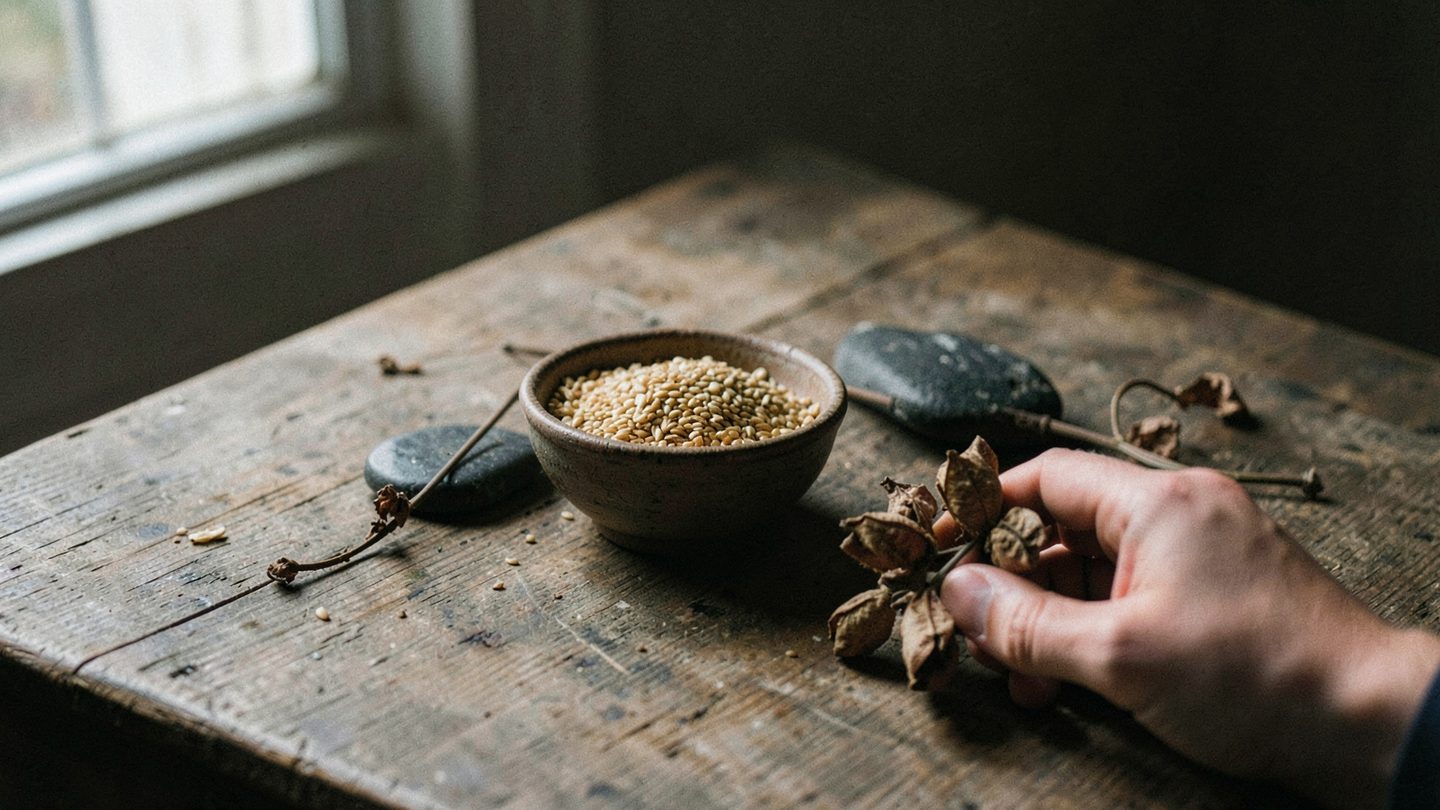
Ceres is the harvest. Pluto is the underworld. Put them on the same degree and you get the oldest story in the book: a mother who loves fiercely and a force that takes what she loves away, then hands it back changed. The Greeks told it as Demeter and Persephone. Astrologers read it as the point where nourishment meets power. Astro.com frames this pair as a symbolic whole built on seasons, fertility, death and rebirth rather than a tidy keyword list, and both editions of that article emphasise the tension between sustaining life and transforming it.
That tension has a shape you can feel. Ceres asks: who feeds me, and who do I feed? Pluto asks: what has to die so something truer can live? When these two lock together, care stops being simple. Feeding someone becomes a way of holding them. Being fed becomes a debt. The person who leaves the table is both abandoning and escaping. This is why the aspect shows up so often in stories about food, bodies, mothers, inheritance, caretaking, and any relationship where love and leverage arrive in the same hand.
Geometrically, the conjunction is a measured separation of a few degrees at most. An exact conjunction is zero degrees apart; a two-degree gap carries a two-degree orb. That precision is what makes the contact felt rather than theoretical. The aspect blends rather than batters, so the two meanings fuse into one instinct. Some people meet it as fierce loyalty to family. Others meet it as a compulsive urge to rescue people who never asked.
Ceres conjunct Pluto is not a verdict. It is a wiring. The sign it falls in colours the style, and the house places it in a specific department of life, which is why the question of whether it means the same thing for everyone who carries it lands firmly on no. Two people with the identical aspect live it in different rooms: one in family, one in work, one in money, one in friendship. The chart around the aspect decides which.
In a natal chart
When Ceres meets Pluto at the same degree of your birth chart, the instinct to nourish and the instinct to transform fuse into one compulsion. You do not just care for people. You take them under your wing in a way that reshapes both of you. It can feel like love, and it can feel like a grip that will not release. The sign and house carrying the conjunction show where this plays out. A conjunction in the fourth house turns family into the arena. In the tenth, it turns career and public role into the place where you feed or control others. In the second, it attaches to money, resources and self-worth.
The house tells you which department of life runs on this fuel. The sign tells you the style. Cancer feeds, protects and remembers. Scorpio bonds through crisis and refuses to let go. Capricorn provides structure, duty and long-term security. Virgo fixes, monitors and manages. When the conjunction lands in the fourth or touches the Moon, home, emotional security and caretaking become the arena, and the feeding instinct runs straight through the people you live with, as it does in Chiron conjunct the Moon. Look at the house first when you want to know where the drama will happen, then the sign for how it will look and feel.
You can also track how the aspect behaves when it is triggered. Because the planets sit on the same degree, any transit to that point hits both at once. A Saturn square or a Mars conjunction to your Ceres-Pluto degree tends to bring the care-and-control dynamic to a head. Compulsive helping, food or body issues, and caregiving burnout often surface around those pressure points, not out of nowhere. The natal aspect is the baseline. The transit is the trigger.
Between two charts
In synastry, one person's Ceres lands on the other person's Pluto within a tight orb. The measured separation is what makes it a conjunction at all: exact is zero degrees, and most astrologers count anything inside roughly eight degrees for a slow-moving body like Pluto. This is the most loaded overlap two charts can share, because one person carries the food and the other carries the power. Run both birth charts through the synastry chart calculator and you will see the direction of that overlap immediately.
The tell for whether it is working is simple: support widens the other person's choices, control narrows them. Watch what each person does rather than what either one privately feels. Under real Ceres-Pluto care, the receiver rests, eats, takes the risk they were avoiding, and still has room to leave. Under the controlling version, the receiver checks in before deciding, apologises for needing anything, and quietly drops the plans they had before the relationship started. The amount of care is not the marker. The direction of the other person's life is.
The direction of contact matters. If your Ceres sits on their Pluto, you are the one pouring care into a person who can reshape you. If their Ceres sits on your Pluto, you are the one whose presence reorganises how they feed and protect. Same degree, opposite experience.
When the contact tightens into a square rather than a conjunction, the same theme turns into friction instead of fusion — see Ceres square Pluto for how that pressure reads.
Composite and Davison charts show the same fusion as a shared project rather than a personal habit: a couple or a business partnership that becomes the place both people go to be looked after, and the place both people fight about who is in charge of it. AstroMatrix reads this pairing as intense, protective and prone to power struggles, which matches the tradition without dressing it up. Astro.com's myth framing adds the missing half: whatever dies between the two of you is supposed to die, and the harvest that follows is real.
Practical next step for a pairing: name the seam out loud. Who is currently feeding whom, and what does the feeder get out of it? Ceres giving that is not chosen is not generosity, it is a bill. Say what you need in plain language before the resentment has to say it for you.
As a transit
When Ceres conjunct Pluto forms as a transit, the planets are moving through the sky together and touching a point in your birth chart. The answer to how long it lasts is: long. Pluto moves about one and a half to two degrees a year, so the alignment can sit on one sensitive degree of your chart for many months, sometimes across two calendar years. There is no single day to circle. The peak is a season, not a moment, and you often only recognise it looking back.
What changes is rarely abstract. Transit Ceres-Pluto reorganises how you feed, protect and let go. A long-running caretaking arrangement reaches its limit. A person you have been holding up needs to stand, or you need to. Something you relied on for daily comfort — a routine, a job, a body pattern, a friendship that kept you fed — either deepens or ends. It is the harvest and the underworld arriving on the same schedule.
The trigger point matters. If the transit falls on your Ascendant, the change lands on your body, identity and how you show up. On the Midheaven, it lands on work, reputation and public role. On the Moon, it lands in home and emotional security. Watch for pressure from a slower planet or an eclipse to that same degree: that is when a simmering question turns into a decision.
You may notice the pattern most clearly in your daily habits. Meals become loaded. Sleep changes. You either start feeding yourself properly for the first time in years or you hand the duty to someone else and let them carry it. Pluto does not do small; the shift tends to be structural, not cosmetic.
Start with a free birth chart to see what the transit actually contacts. Then the transit chart calculator compares the sky at that date with your birth chart, so the contacts show up as specific placements rather than a general mood. Run it for the start, middle and end of the span, and you will see which natal points the alignment is working through.
One caution that follows from the geometry: Ceres and Pluto meet at exactly zero degrees apart at the peak, and anything inside two degrees counts as a tight conjunction. That precision is what makes the transit felt rather than theoretical. A wide, loose contact drifts by. A tight one puts its hands on your life.
If the aspect is not touching a natal planet at all, it may pass with only a faint theme: a season of heavier caretaking, a sharper awareness of who depends on whom. That is still useful. You just will not be forced to rebuild anything.
Practical examples
The quickest way to understand this aspect is to hear it in the room. Three short scenes show how the identical conjunction behaves differently depending on the chart it lands in and the person carrying it.
Scene one, natal. A woman with Ceres-Pluto in Virgo looks after her aging father. She cooks his meals, tracks his medication, arranges his appointments, and genuinely loves doing it. She also answers every suggestion from her brother with a list of reasons he is wrong. The care is real. So is the grip. When her father says he wants to try the day centre, her first instinct is to explain why they cannot manage it. The wiring is nurture fused with control. The next step is not to stop caring; it is to notice where her care answers a question he did not ask.
Scene two, synastry. Her Ceres sits on her partner's Pluto. For years she has been the one who makes the home work: the meals, the calendar, the emotional first aid. He holds the power to make all of it feel received or worthless, often with one flat sentence. She pours, he judges, and both call it a normal relationship. The tell from earlier — does the receiver grow or shrink — points straight at him. Under her care he rests, eats and softens. In the months when she withholds, he withdraws entirely. Both of them have outsourced their stability to the other's performance.
Scene three, transit. A man in his fifties has transit Ceres-Pluto reaching his natal Moon. His mother, who has lived with him for two years, is now ready for supported housing. For months he has framed her staying as family duty. Around the exact contact he admits, in one long evening, that he wanted her there because the house felt empty. The change is small and enormous: she moves, he feels the hollowness, and he starts cooking for himself for the first time since his divorce. The transit did not break the bond. It repriced it.
Scene four is the quiet one. A reader checks his chart and finds Ceres and Pluto ten degrees apart and touching nothing else. No scenes, no dramas. He just notices that for the past year he has been the default caretaker in his friendship group, and he starts saying no occasionally. That is a Ceres-Pluto season working softly. Not every version of this aspect needs a crisis to matter.
If you have finished the examples and want to see where your own Ceres-Pluto contact sits in the whole chart, the birth chart calculator lays out the placements and connections around it. The aspect alone is one sentence. The chart finishes the story.
Common questions
How do you tell a real Ceres conjunct Pluto contact from a loose one? Measure the separation, not the feeling. A conjunction puts both bodies at the same degree, and an exact contact is zero degrees apart. A two-degree gap carries a two-degree orb, and anything inside roughly eight degrees still counts for a slow body like Pluto. A wide gap is a theme that visits, not a permanent condition.
Does it mean the same thing for everyone who has it? No — and that is the whole point. The wiring is shared, care fused with transformation, but the house decides the life area and the sign decides the style. One person feeds and controls in family. Another does it at work. A third does it with money or friends. Same aspect, different room.
What if Ceres and Pluto sit close but never make an exact contact? You get the theme at low volume: a habit of over-giving that you can name and adjust rather than a force that reorganises your life. Useful information, and far less dramatic than the exact version.
Which other placements change the reading most? Ceres to Pluto first, in either direction, then the Moon for emotional security, the Sun for identity, Venus for how love is given, and Mars for how care turns into action when it meets resistance. A body sitting tight to that degree adds its own voice. None of them replaces the core question: who feeds whom, and what does the feeder get out of it?
Where does the synastry version sit if neither chart has the aspect alone? It lives in the space between the two charts, not inside either person. That is why it behaves like pressure from outside the relationship rather than a private habit — the same reason Pluto opposite the Moon reads as an external force on your emotions.
What input actually changes the answer? Birth time. Houses and angles need your birth date, an accurate birth time and a birth location. Without a time, the planets keep their signs but the house stays uncertain — and so does the life area. If the Moon changed signs on your birth day, even the Moon sign can remain unclear until you confirm it. Pull the time from a birth certificate or family record before you build a reading on a house you are guessing at.
Want the placements around your own contact? The free birth chart lays out every planet and point near your Ceres-Pluto degree, so you can see the house, the sign and the neighbours instead of imagining them. The aspect is one sentence. The chart is the paragraph it sits in.
When the aspect is not the whole story
A single conjunction never explains a whole chart. Ceres and Pluto can sit on the same degree and still be outweighed by a tight Sun-Saturn square, a crowded seventh house, or a Moon that needs far more attention than either dwarf planet. Read the aspect as one voice in a conversation, not the verdict.
The Moon matters more than most readers expect. If your Moon sits near the Ceres-Pluto degree, care and loss run through your emotional baseline, and every caretaking decision carries extra weight. If your Moon is elsewhere and quiet, the same aspect plays out more like a policy you can revise than a feeling you cannot escape.
Venus and Mars change the surface texture. Venus channels the pairing into how love is given and received; Mars channels it into what happens the moment care meets resistance. Neither replaces the core question, but they decide whether the story plays as devotion, as rescue, or as a fight about who is owed what.
Check whether Ceres is retrograde in your chart. A retrograde Ceres turns the feeding instinct inward: you may be far better at looking after other people than at letting anyone look after you, and the Pluto side can then read as a private reckoning rather than a public power struggle.
Finally, look at how empty or crowded that degree is. A Ceres-Pluto contact standing alone behaves cleanly. A contact buried among other placements becomes one thread in a much larger knot, and reading it in isolation will send you looking for drama that belongs to a different part of the chart.
That is the practical reason to see the full chart rather than a single aspect. The free birth chart calculator shows every planet and point near your Ceres-Pluto degree, so you can judge how loud this one voice actually is before you let it narrate your whole life.
| Placement nearby | What it changes | What to do |
|---|---|---|
| Moon on the Ceres-Pluto degree | Care and loss become emotional baseline, not just behaviour | Protect rest and ask directly for what you need |
| Venus on the degree | Love and nourishment fuse; giving becomes the way you show affection | Notice when giving is used instead of saying what you want |
| Mars on the degree | Care turns into action the moment resistance appears | Pause before rescuing; ask if help was requested |
| Retrograde Ceres | Feeding turns inward; receiving care is the harder skill | Practise accepting help in small, low-stakes ways |
| Quiet degree, nothing nearby | The theme visits rather than dominates | Name the over-giving habit and adjust it deliberately |
Calculation note · Worked aspect calculation — illustrative longitudes
- Conjunction reference angle
- 0°
- Example measured separation
- 2°
- Example orb
- 2°
This numerical example explains aspect geometry. It is not a real natal or relationship chart, a compatibility score, or evidence of a psychological effect.
Sources
This article reads Ceres and Pluto as astrological symbols, not measured psychological effects. Ceres is a dwarf planet orbiting in the asteroid belt and Pluto a dwarf planet in the Kuiper Belt; their conjunction is an apparent alignment from Earth's viewpoint. Houses, angles and a rising sign need birth date, an accurate birth time and birth location, and a date alone cannot always fix the Moon sign.